
 info@baolaipipes.com
  +86-13821217904

The actual outside diameter (OD) of a 1/2-inch galvanized pipe is 0.840 inches (21.34 mm). While the name suggests a 0.5-inch width, “1/2 inch” is a Nominal Pipe Size (NPS)—a standard naming convention rather than a literal measurement of the pipe’s exterior.
For quick project planning, here are the essential 1/2-inch galvanized pipe specs:
- Actual Outside Diameter (OD): 0.840 inches (21.34 mm)
- Approximate Circumference: 2.64 inches (67.0 mm)
- Recommended Hole Saw Size: 7/8 inch (tight fit) or 1 inch (standard clearance)
- Common Standard: Schedule 40 (Standard Wall)
Whether you are drilling through a wall stud, buying pipe hangers, or designing industrial furniture, you must plan your clearances around the 0.840-inch reality rather than the half-inch name. Using a 0.5-inch reference will lead to mismatched fittings and drill bits that are far too small for the job.
Why The Name Of A 1/2 Inch Galvanized Pipe Is So Confusing?
If you’ve ever felt frustrated that your tape measure doesn’t match your pipe’s label, you aren’t alone. The term “1/2 inch” is what we call a Nominal Pipe Size (NPS). In the world of industrial piping, “nominal” essentially means “in name only.”
Nominal Size vs. Actual Measurement
Historically, a 1/2 inch galvanized pipe was designed to have an inside diameter of roughly 0.5 inches to ensure a specific water flow rate. Back then, pipe walls were thick and inconsistent. As manufacturing technology improved, we were able to make pipe walls thinner while maintaining the same strength.
However, the industry couldn’t just change the outside diameter because all the existing fittings—the elbows, tees, and valves—were already sized to fit that specific exterior width. Consequently, the outside diameter remained fixed at 0.840 inches, while the “hole” in the middle got larger. Today, the name “1/2 inch” is simply a category that tells you which fittings will work with the pipe.

Detailed 1/2 Inch Galvanized Pipe Dimensions And Specs
To plan your project successfully, you need to know more than just the outer width. You need to know how much space the pipe takes up and how much fluid it can carry. Even though the 0.840 pipe OD is constant, the wall thickness can vary based on the “Schedule.”
| Pipe Property | Imperial Measurement | Metric Measurement |
| Nominal Size (NPS) | 1/2 inch | 15 mm (DN15) |
| Actual Outside Diameter (OD) | 0.840 inches | 21.34 mm |
| Circumference (Distance Around) | 2.639 inches | 67.03 mm |
| Schedule 40 Wall Thickness | 0.109 inches | 2.77 mm |
| Schedule 40 Inside Diameter (ID) | 0.622 inches | 15.80 mm |
How Schedule 80 Changes The Inside?
If you are working on a high-pressure system, you might be using Schedule 80 pipe. While the outside is still 0.840 inches, the walls are much thicker (0.147 inches). This means the “hole” in the middle shrinks to 0.546 inches. If you are trying to slide an internal sensor or a cleaning tool inside the pipe, always check your schedule first.
The “Will It Fit?” Solution: Choosing The Right Drill Bit
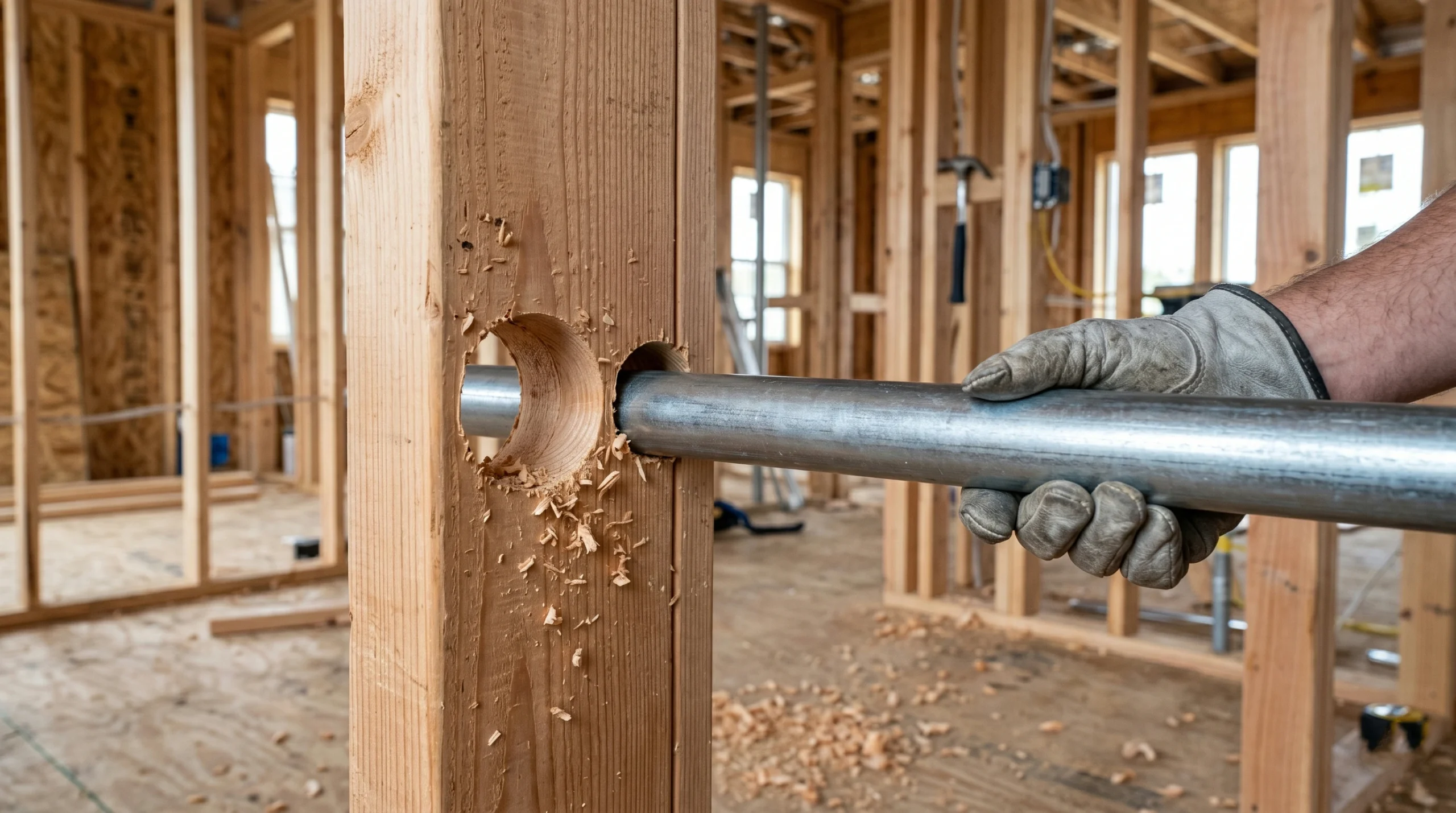
One of the most frequent reasons people search for the OD of a 1/2 inch galvanized pipe is that they are standing in a kitchen or garage needing to drill a hole through a wall or a stud.
Step-By-Step Guide To Drilling For Pipe Clearance
If you drill a 1/2-inch hole, your pipe won’t even come close to fitting. Use these steps to choose the right bit for your specific needs:
- For a Tight, Professional Fit: Use a 7/8-inch (0.875″) spade bit or hole saw. This gives you exactly 0.035 inches of wiggle room. It’s perfect for finished cabinetry where you want a clean look without a massive gap.
- For Standard Framing (Studs and Joists): Use a 1-inch bit. This is the industry standard. It allows the pipe to slide through easily, even if your hole isn’t perfectly straight.
- Accounting for Thermal Expansion: Steel pipes expand and contract with temperature changes. If the pipe is carrying hot water or steam, a 1-inch hole is mandatory. A tight fit can lead to “ticking” or “knocking” sounds in your walls as the pipe rubs against the wood.
How To Identify A 1/2 Inch Galvanized Pipe Without Calipers?
What if you are looking at an old pipe in a crawlspace and aren’t sure if it’s a 1/2-inch or a 3/4-inch line? You don’t need expensive digital calipers to find out.
The String Test For Measuring Circumference
Since most of us don’t carry calipers in our pockets, you can use a simple piece of string or even a shoelace to identify a half inch steel pipe.
- Step 1: Wrap a string around the outside of the pipe once.
- Step 2: Mark the point where the string overlaps.
- Step 3: Lay the string flat against a standard ruler or tape measure.
- Step 4: Compare your measurement. If the string is roughly 2-5/8 inches (2.64″), it is a 1/2-inch pipe. If the string is over 3-1/4 inches, you are looking at a 3/4-inch pipe.
The “Coin Test” Identification Trick
If you have some change in your pocket, a U.S. Nickel is almost exactly 0.835 inches in diameter. If you hold a nickel up to the end of a cut pipe and it almost perfectly covers the outside diameter, you are looking at a 1/2-inch galvanized pipe.
Common Problems When Buying Hardware And Clamps
The “Nominal Size” confusion often leads to buying the wrong mounting hardware. This is where most DIY projects hit a wall.
The IPS vs. CTS Trap
There are two different sizing standards for hardware. IPS (Iron Pipe Size) is for galvanized and black iron pipe. CTS (Copper Tube Size) is for copper and PEX.
- A 1/2-inch copper pipe (CTS) has an OD of 0.625 inches.
- A 1/2-inch galvanized pipe (IPS) has an OD of 0.840 inches.
The Problem: If you buy a “1/2-inch pipe strap” from the plumbing aisle, check the label. If it’s for copper, it will be nearly 1/4-inch too small for your galvanized pipe. Always look for hardware labeled IPS or 0.840 OD.
Advanced Concerns: Zinc Coating And Thread Taper
For those working on professional-grade builds or industrial furniture, there are two “hidden” variables that affect the outside diameter of a 1/2 inch galvanized pipe.
The Zinc Coating Variable
Galvanized pipe is made by dipping raw steel into molten zinc. This “hot-dip” process adds a layer of protection that is usually between 0.003 and 0.005 inches thick. While this sounds tiny, it can make the pipe feel “fat” when trying to slide it into a precision-machined sleeve or a tight-fitting industrial flange.
Understanding NPT Tapered Threads
Galvanized pipes use National Pipe Thread (NPT). These threads are not straight; they are tapered at a rate of 1/16 inch per inch of length.
- The Problem: This means the outside diameter actually gets slightly smaller at the very tip of the pipe and wider as you move back toward the middle.
- The Solution: Always measure the “smooth” part of the pipe for an accurate reading, as threads can throw off your calipers by a few millimeters.
Frequently Asked Questions
Is 1/2 inch galvanized pipe the same as 1/2 inch conduit?
No. Electrical Metallic Tubing (EMT) conduit has an OD of 0.706 inches. Galvanized plumbing pipe is much thicker and heavier, with an OD of 0.840 inches. They are not interchangeable.
Can I use 1/2 inch PVC fittings on galvanized pipe?
No. While the nominal sizes match, the threads are often different, and the materials expand at different rates. Mixing them usually leads to leaks.
Recommended Reading: Need to see how the 1/2-inch size fits into the full spectrum of piping standards? Explore our Steel Pipe Sizes and Dimensions Chart: Complete Guide for a side-by-side comparison of all pipe schedules and diameters.
Conclusion: Build With Confidence And Precision
Whether you are a homeowner fixing a garden line or a procurement officer managing a massive industrial order, understanding that a 1/2 inch galvanized pipe is actually 0.840 inches wide is the key to a successful build. By planning your drill bits, clamps, and clearances around this number, you eliminate the “nominal confusion” that causes so many projects to fail.
At Baolai Ppipes, we specialize in providing factory-direct, ASTM-certified galvanized piping with absolute dimensional consistency. We help B2B buyers and contractors move past the “Nominal Lie” by providing exact specifications for OD, wall thickness, and zinc weight.
Stop guessing on your Bill of Materials. Contact our sales and engineering team today for a full-line specification chart or a bulk quote on precision-tested galvanized piping for your next project.


